
Loop: for each item

Goal

Run a block once per array item and use the collected results. Time: 15 minutes.
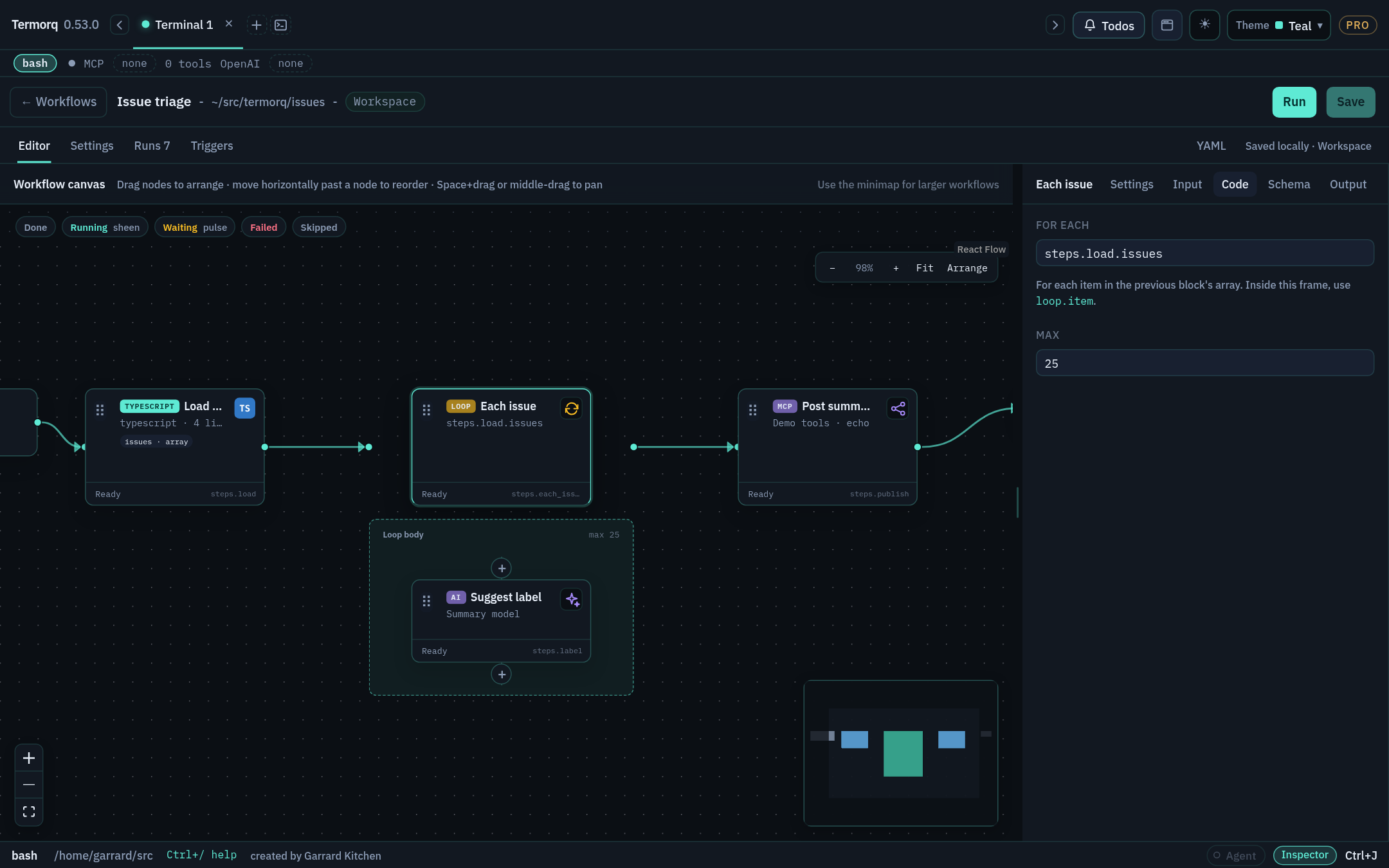
Loop “Each issue” with a nested AI block in its Loop body frame, and For each and Max in the inspector Loop “Each issue” with a nested AI block in its Loop body frame, and For each and Max in the inspector

schema: 1
name: Loop names
id: loop-names
blocks:
  - id: names
    kind: code
    language: python
    body: |
      import json; print(json.dumps({"items": ["Ada", "Lin", "Grace"]}))
    outputs:
      type: object
      properties:
        items: { type: array, items: { type: string } }

  - id: each_name
    kind: loop
    for_each: steps.names.items
    max: 20
    body:
      - id: greet
        kind: code
        language: python
        uses: [loop.item, loop.index, loop.count]
        body: |
          import json, os
          d = json.load(open(os.environ["TERMORQ_INPUT"], encoding="utf-8"))["loop"]
          print(json.dumps({"greeting": f"Hello {d['item']} ({d['index']}/{d['count']})"}))
        outputs:
          type: object
          properties:
            greeting: { type: string }

  - id: count_passes
    kind: code
    language: python
    uses: [steps.each_name.results]
    body: |
      import json, os
      r = json.load(open(os.environ["TERMORQ_INPUT"], encoding="utf-8"))["steps"]["each_name"]["results"]
      print(json.dumps({"count": len(r), "first": r[0]["greet"]["greeting"]}))
    outputs:
      type: object
      properties:
        count: { type: number }
        first: { type: string }

Loop facts

FactValue
Loop contextloop.item (the current element), loop.index (starts at 1), loop.count
Outputsteps.<loop id>.results: one object per pass, keyed by child block ID, plus status and exit
maxDefaults to 20, and the ceiling is 100
Passes per run100 in total, across all loops
NestingUp to 2 levels deep
Blocks per file40, including loop bodies

In the editor, a loop is a frame. Add blocks with the + inside the frame, or drag existing blocks into it. While it runs, the frame shows progress such as 3 of 12. Keep the - id: of each child indented under body: in YAML.

Check your run

count_passes publishes count: 3 and first: "Hello Ada (1/3)". On Runs, greet appears three times, once per pass.

Exercise

Replace the inline names block with a workflow input: declare inputs: names: {type: array, items: {type: string}} and loop over inputs.names.

Details
inputs:
  names:
    type: array
    items: { type: string }
blocks:
  - id: each_name
    kind: loop
    for_each: inputs.names
    body: [ ...same greet block... ]

When you press Run, enter the names. An HTTP trigger can supply them as {"names":["Ada","Lin"]}.